
Day 3 - LLM Providers Compared: OpenAI, Claude, Gemini, Ollama, Groq
Week 1 · Day 3 · Lecture 12. Day 2 was all theory. Today you start calling a lot of LLMs — paid and free, cloud and local — so this lecture is your quick map of who the providers are before the lab throws you at all of them at once.
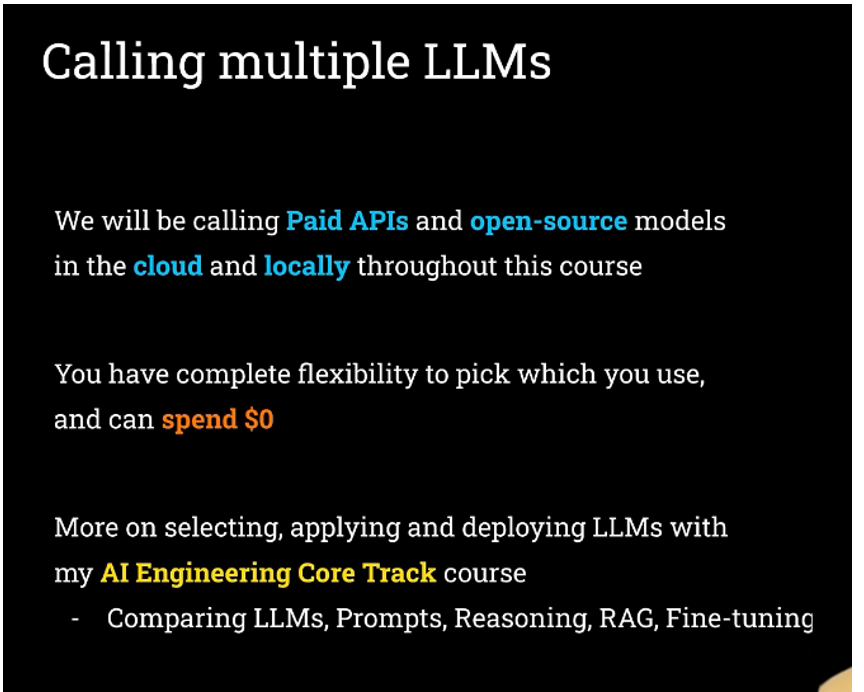
You don't have to spend anything
Every lab in this course can be run entirely on free or open-source models — that's a deliberate design choice, not a footnote. The trade-off is real, though: free models are less capable, so you'll need to iterate more, tighten your prompts, take smaller steps, and sometimes ask for less than you would from a top-tier paid model. That extra iteration is not a tax on learning — it is the learning. Working around a weaker model's limits teaches you more about how LLMs behave than a flawless first answer from an expensive one ever will.
If you want to go deeper on model selection, prompting, reasoning models vs. chat models, RAG, and fine-tuning, that's the focus of the companion AI Engineering Core Track course. It shares little with this course beyond the first week, but its first two weeks build foundations — system vs. user prompts, tokens, the chat completions API — that complement what you're doing here.
The cast of characters
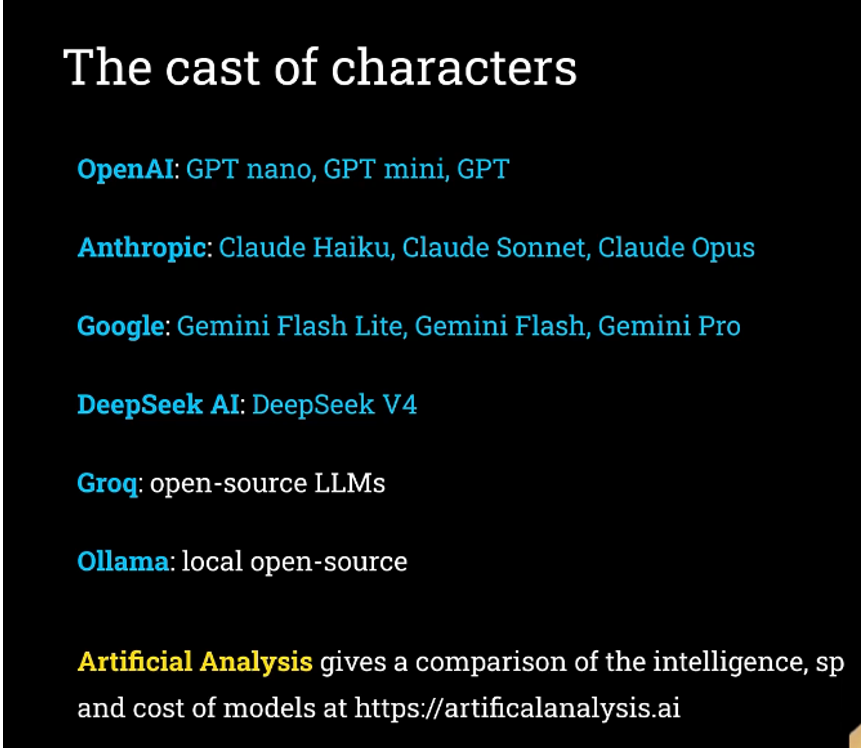
The three major LLM providers each ship a family of models in three sizes — small/cheap, medium, and large/strongest:
| Provider | Small | Medium | Large |
|---|---|---|---|
| OpenAI | GPT Nano | GPT Mini | GPT |
| Anthropic | Claude Haiku | Claude Sonnet | Claude Opus |
| Gemini Flash Lite | Gemini Flash | Gemini Pro |
All of Anthropic's models are called Claude — Haiku, Sonnet and Opus are to Claude what Nano, Mini and the base model are to GPT. The exact version numbers will already be out of date by the time you watch this — new models ship every week. Use whatever's current; check OpenAI's model page or the instructor's YouTube channel (which puts new releases through informal tests) for the latest.
Beyond the big three:
- DeepSeek AI — a Chinese AI startup, notable for being among the first to open-source a genuinely large, capable model. Run a smaller version yourself, or have DeepSeek (or another inference provider) run the full-size model for you.
- Groq (spelled with a Q) — not a model-maker but an inference provider: a cloud platform that runs open-source models for you, very fast. Not to be confused with Grok (spelled with a K), Elon Musk's LLM from x.AI — Groq-with-a-Q actually used that name first.
- Ollama — software that runs open-source models locally on your own machine. Not as large as DeepSeek's full-size models, but plenty of small distilled models (including a tiny DeepSeek release) run comfortably on a laptop. This is what the course uses for local inference.
- OpenRouter — not a model provider either, but a routing layer: one API key and account that forwards your requests to OpenAI, Anthropic, Gemini, Groq, Grok, or others, for a small margin on top (a few percent). Convenient if you don't want separate accounts and balances with every provider. Covered in more depth in the Core Track and the course's Guide 9.
Artificial Analysis is worth bookmarking — it compares the intelligence, speed and cost of models across providers in one place. Benchmarks aren't gospel (take them with a pinch of salt), but it's a solid starting point for judging what a model is actually good for.
Three things to keep in mind at all times
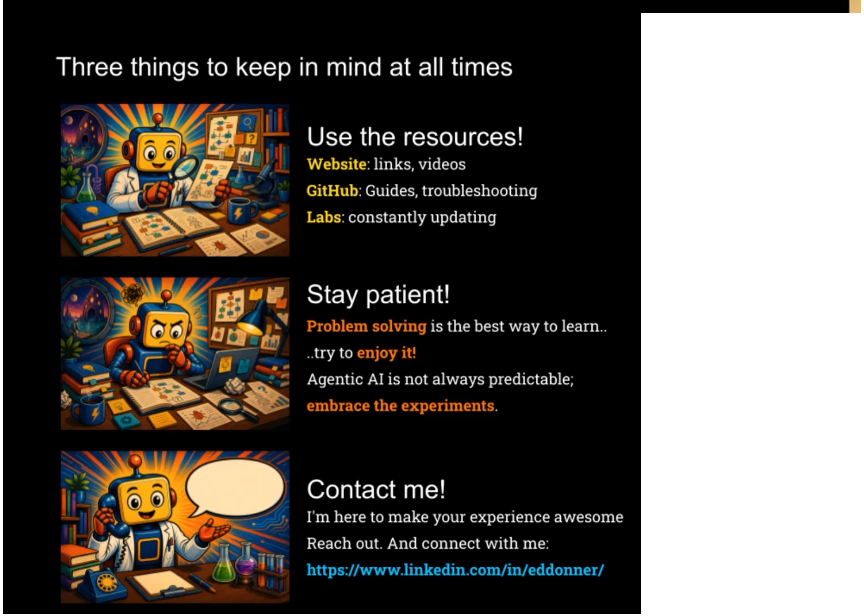
- Use the resources. The course website (links, videos), the GitHub repo (guides, troubleshooting), and the labs themselves (constantly updated) all have more detail than the lectures alone.
- Stay patient. Problem-solving is the best way to learn — try to enjoy it, even when it's frustrating. Agentic AI is not always predictable (a theme from the last lecture); embracing the experimentation is part of the process, not a sign something's wrong.
- Reach out. The instructor is reachable via Udemy Q&A and email, and open to connections on LinkedIn.
What you should now understand
- You can complete every lab in this course for $0 using free/open-source models — it just takes more iteration.
- OpenAI, Anthropic and Google each ship a small/medium/large family of models (GPT Nano/Mini/GPT; Claude Haiku/Sonnet/Opus; Gemini Flash Lite/Flash/Pro).
- DeepSeek is a model provider; Groq and OpenRouter are not — Groq is a fast inference provider for open-source models, and OpenRouter is a single-key router across providers.
- Ollama runs smaller open-source models locally on your own machine.
- Artificial Analysis is a good source for comparing model intelligence, speed and cost.
Resource links
- Artificial Analysis — compare LLM intelligence, speed and cost
- OpenRouter — one API key, routed to any provider
- Ollama — run open-source LLMs locally
- Groq — fast inference for open-source models
- Course resources page
- This lecture on Udemy
Next
Straight into the lab: setting up multiple LLM API keys and generating a question to ask across all of them.